Nitrogen is the main growth factor present in grapes for yeast growth and fermentation, and can impact the production of aroma compounds. Its deficiency can lead to the production of hydrogen
sulphide (H2S) and stuck or sluggish fermentations (Jiranek et al 1995). Yeast require nitrogen for cell growth and efficient fermentation. In the first third of fermentation the yeast will build in biomass sufficient to metabolise the level of sugar present. Yeast biomass is also impacted by whether the strain has a high or low nitrogen requirement. Yeast assimilable nitrogen (YAN) can be found in two forms; mineral or organic. In grapes, mineral nitrogen makes up one third of the total nitrogen, whilst the organic fraction makes up two third to three quarters of the grape derived of YAN.
Getting an indication of vineyard nutrition deficiencies enables a winemaker to avoid dealing with stuck and sluggish fermentations. It also allows the winemaker to prevent H2S formation and maximise fruity aromas in the final wines. YAN can be measured enzymatically to give an absolute result. YAN is a measurement of ammonia nitrogen (FAN) and primary amino nitrogen (PAN). A DAP addition represents a mineral nitrogen or an ammonia addition, but not organic or amino nitrogen. Hydrogen sulphide production is linked to a deficiency in amino or organic nutrition, whereby the timing of addition is critical.
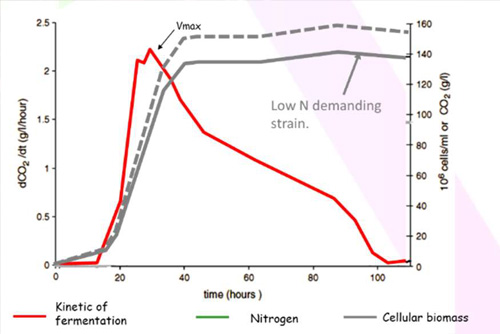
Figure 1. Assimilation of N and production of biomass for a high and a low N demanding strain during alcoholic fermentation.
Personal communication Marina Bely, University of Bordeaux.
Measure YAN in must and supplement nitrogen in both organic and inorganic forms accordingly.
Critical points in alcoholic fermentation are:
REFERENCES
Jiranek, V.; Langridge, P.; Henschke, P.A. (1995) Amino acid and ammonium utilization by Saccharomyces cerevisiae wine yeasts from achemically defined medium. Am. J. Enol. Vitic. 46: 75–83.
Henschke, P.A.; Jiranek, V. (1993) Yeasts – metabolism of nitrogen compounds. In: Fleet, G. H., ed. Wine microbiology and biotechnology. Chur, Switzerland: Harwood
Academic Publishers. pp 77–164.
Mestres M, Busto O, Guasch J. Analysis of organic sulfur compounds in wine aroma.
Journal of chromatography A. 2000 Jun 9;881(1-2):569-81.
Mendes-Ferreira A, Barbosa C, Inês A, Mendes- Faia A. The timing of diammonium phosphate supplementation of wine must affects subsequent H2S release during fermentation.
Journal of applied microbiology. 2010 Feb;108(2):540-9.